
 English

Views: 0 Author: Site Editor Publish Time: 2026-10-06 Origin: Site


Applying crop protection in modern orchards demands a precarious balance. You must maximize chemical efficacy while simultaneously minimizing environmental drift. When operators configure equipment improperly, the results are immediate and damaging. You experience severe chemical runoff, exhausted operating budgets, and insufficient pest control. Achieving optimal canopy coverage is not about simply pumping higher volumes of liquids into the trees. Instead, it requires a precise, mathematical alignment of air delivery, droplet spectrum, and fluid flow rate. We built this guide to provide a rigorous framework for evaluating your current setup. You will learn how to troubleshoot poor coverage effectively. We will also help you make informed calibration and hardware decisions moving forward.
Fan limits dictate coverage: Air volume must displace the air currently inside the canopy; excessive velocity pushes chemicals entirely through the target row, causing drift.
Nozzle selection controls droplet physics: Using the correct orchard sprayer nozzle determines droplet size, which directly impacts surface retention and evaporation rates.
Pressure is a fine-tuning mechanism, not a force multiplier: Cranking up orchard sprayer pressure reduces droplet size and increases drift potential rather than improving deep canopy penetration.
Validation is non-negotiable: Mathematical calibration must always be visually verified using water-sensitive paper and airflow ribbon tests.
Defining success begins with quantifiable metrics. Industry standards dictate what constitutes solid coverage. You typically need to achieve 85 spray deposits per square centimeter. Furthermore, you should observe 10–15% total coverage on water-sensitive paper. Hitting these numbers ensures contact chemicals perform correctly. Missing these benchmarks creates massive financial leaks across your operation.
Over-spraying rapidly consumes your chemical budget. It also forces mechanical components to work harder. This accelerates unnecessary wear on pump diaphragms and drivetrain components. Poor calibration carries significant hidden impacts:
Chemical Waste: Pumping excess volume rarely improves pest mortality. It simply washes expensive active ingredients into the soil.
Accelerated Wear: Running pumps at maximum capacity shortens bearing life. It also stresses tractor power take-off (PTO) systems unnecessarily.
Soil Compaction: Carrying larger tanks to compensate for poor coverage requires heavier tractors. This drives severe rutting and soil compaction in your rows.
Beyond direct expenses, compliance risks loom large. Regulatory agencies aggressively monitor off-target drift. They also track chemical runoff in local agricultural watersheds. Precision protects your crops and your operational reputation. Finally, consider the operator variable carefully. Tractor speed heavily dictates spray success. We often see operators speed up to finish a block quickly. A setup perfectly calibrated at 3 MPH will fail completely at 4 MPH. The fan simply lacks the time to displace canopy air.
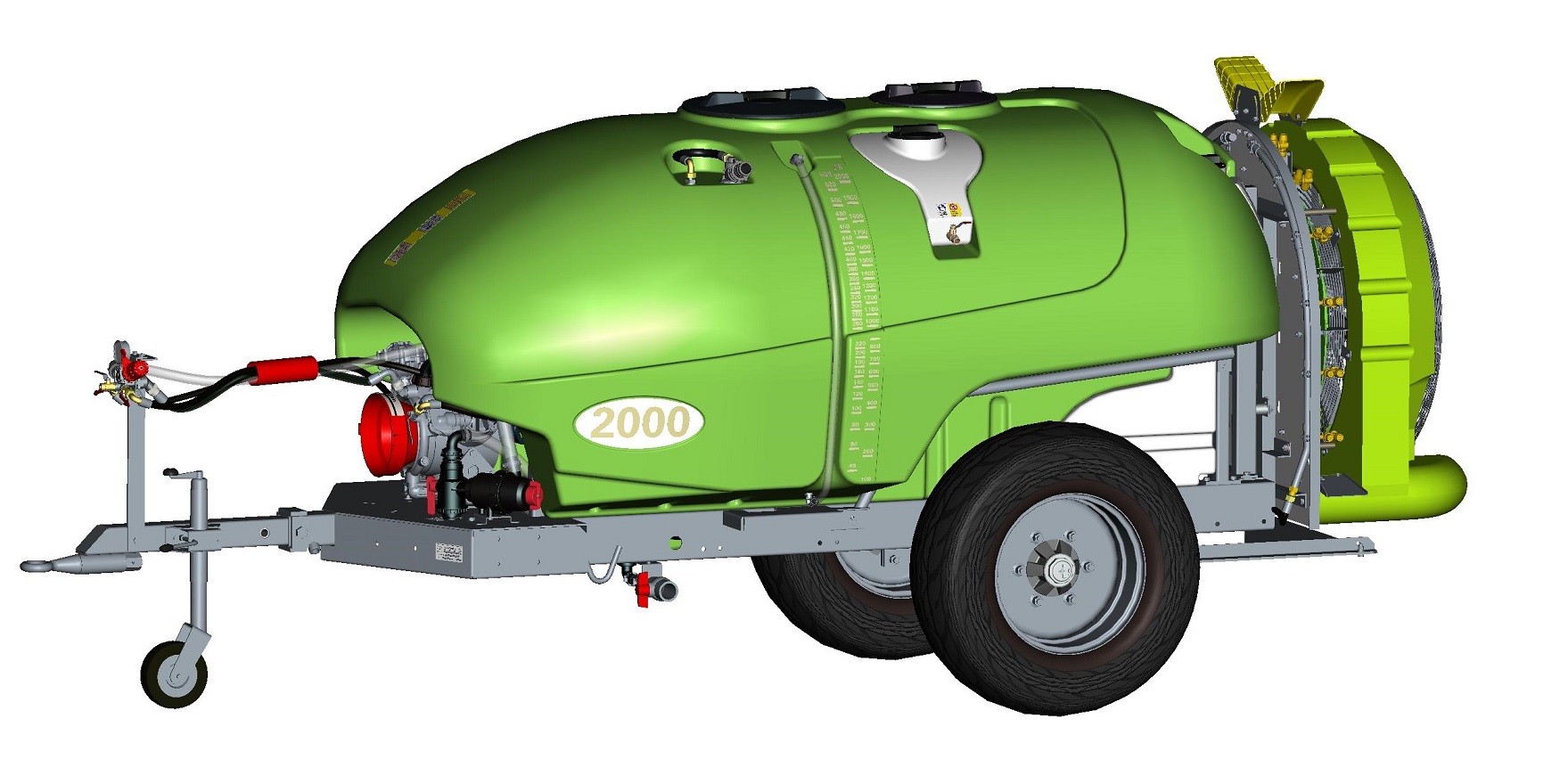
Air acts as the primary vehicle for your chemical application. The orchard sprayer fan exists solely to transport droplets to the target. It should gently flutter the foliage. This gentle movement coats both sides of the leaf. It is not designed to aggressively blast the tree structure.
Understanding volume versus velocity is an essential skill. You must accurately calculate canopy volume. Measure the height of the canopy. Measure the width of the canopy. Multiply these two figures by the forward speed of the tractor in feet per minute. This baseline formula dictates the minimum cubic feet per minute (CFM) your fan must generate. You need enough CFM to displace the existing ambient air inside the tree.
High air velocity creates severe operational risks. Too much speed causes leaves to shingle together. They stack flat against one another, effectively blocking inner canopy access. High velocity also blows spray completely through the target row. This sends expensive chemicals drifting into adjacent properties.
Operators must evaluate hardware settings strategically. Test different gearbox settings. High gear moves more air, while low gear handles sparse foliage better. Check fan pitch limits based on current seasonal density. Additionally, leverage deflectors and tower attachments. These structural components direct air horizontally into the crop. They stop the fan from blowing product radially into the open sky.
Droplet size directly influences chemical efficacy and environmental safety. Fine droplets provide exceptional surface coverage. However, they carry a high risk of off-target drift. They also evaporate rapidly in dry climates. Coarse droplets resist drift effectively. Yet, they risk coalescing and dripping off the leaves, causing chemical runoff.
Using the proper orchard sprayer nozzle is absolutely non-negotiable. You must pair the hardware with your specific active ingredient. Hollow cone models produce fine mists. These work perfectly for contact fungicides. Alternatively, air-induction models generate larger, air-filled droplets. These coarser droplets suit systemic applications beautifully.
Material durability requires attention during selection. Ceramic components resist harsh chemical wear significantly longer. Polymer and stainless steel alternatives degrade much faster under heavy use.
Nozzle Material Wear Resistance Comparison
Material Type | Wear Resistance | Cost Profile | Best Application |
|---|---|---|---|
Ceramic | Excellent | High | Abrasive wettable powders |
Stainless Steel | Good | Moderate | Standard liquid formulations |
Polymer / Plastic | Fair | Low | Non-abrasive chemicals |
Brass | Poor | Low | Light use or emergency backup |
Avoid installing uniform nozzle sizes across your entire manifold. Zonal targeting yields far superior field results. Place your larger capacity nozzles in the top two-thirds of the manifold. This strategy directs chemical volume toward the densest foliage. Shut off the lowest positions completely. This prevents you from wasting product on the orchard floor.
A dangerous myth plagues many orchard management programs. Operators often believe higher pressure equates to deeper canopy penetration. This is factually incorrect. Penetration remains the exclusive job of the fan. Operating orchard sprayer pressure acts only as a flow control and atomization mechanism.
Grasping the physics of pressure prevents costly calibration errors. When you double the pressure, you do not double the output. You only increase the flow rate by roughly 40%. However, this aggressive pressure spike significantly shrinks your droplet spectrum. Smaller droplets exponentially increase your off-target drift risk.
Pressure Adjustment Impact on Droplet Dynamics
Pressure Adjustment | Flow Rate Change | Droplet Size Impact | Drift Potential |
|---|---|---|---|
Increase by 25% | Minimal (+~11%) | Slight reduction | Moderate increase |
Double Pressure (100% Increase) | Moderate (+~40%) | Significant reduction | High risk |
Decrease by 50% | Drop by ~30% | Noticeable increase | Minimal risk |
Establish strict operating parameters for your fleet. Standard hollow cone models typically perform best between 60 and 150 psi. Always consult specific manufacturer specifications. They define the precise optimal performance zones for each model.
System pressure also indicates overall mechanical health. Gauges help you diagnose blockages rapidly. They also warn you about premature pump wear. Mounting a highly visible, liquid-filled gauge near the tractor console represents a critical hardware upgrade. It empowers the operator to monitor stability continuously.
Mathematical calibration provides an excellent starting point. However, field validation ensures real-world agronomic success. We strongly recommend implementing a strict three-step verification protocol. Perform these steps for every machine in your fleet.
Ribbon Testing (Airflow): Tie brightly colored ribbons to the sprayer deflector. Attach more ribbons to the upper canopy branches. Drive the tractor at your targeted operational speed. Visually confirm the air direction. The airflow must stop just past the target row. This proves the energy dissipates correctly within the canopy.
Water-Sensitive Paper (Coverage): Place indicator paper strategically throughout the test trees. Attach them to the top, middle, bottom, inside, and outside zones. Run a test pass with clean water. Interpret the cards immediately. Look closely for shadowing. Watch out for heavy runoff, indicated by cards turning completely blue. Ensure adequate deposition across all zones.
Seasonal Recalibration: Canopy densities shift drastically throughout the growing year. Calibration settings optimized for early-season dormant sprays will fail completely by mid-summer. Full-foliage canopies require different air volumes. Recalibrate your fleet as canopy volume expands.
When purchasing replacement equipment, match the machine architecture to your specific orchard layout. A modern Airblast Orchard Sprayer comes in several distinct configurations. Traditional radial profiles work well for standard, freestanding trees. In contrast, tall tower profiles align perfectly with high-density trellis systems. Towers deliver air horizontally, matching modern vertical canopies.
Evaluate future electronic upgradability before signing purchase orders. Can you easily retrofit the manifold later? Look for compatibility with pulse-width modulation (PWM) systems. Check if the controller supports variable rate technology (VRT). These precision upgrades reduce chemical waste significantly over a machine's lifespan.
Finally, practice rigorous vendor vetting. Verify exact pump capacity limits under heavy loads. Review independent gearbox reliability ratings. Most importantly, confirm OEM replacement parts sit locally in your specific agricultural region. Experiencing unexpected downtime during critical spray windows destroys crop yields.
Optimal canopy coverage requires a deeply orchestrated balance of mechanics and applied physics. The nozzle sizes the droplet. The pressure dictates the fluid flow. The fan delivers the mixture accurately to the target.
Do not alter your hardware without running a baseline water-sensitive paper test first.
Treat calibration as a recurring seasonal requirement, not an annual chore.
Monitor driving speeds rigorously to ensure air volume fully penetrates the canopy.
Take action today. Consult with an agronomic equipment specialist to review your current setups. Download a standardized calibration checklist. Begin optimizing your existing fleet before the next critical spray window opens.
A: Replacement frequency depends heavily on the component material. Ceramic models last significantly longer than brass or polymer alternatives. It also depends on the abrasiveness of the chemicals you apply. We recommend checking individual flow rates against manufacturer specifications annually. Replace them immediately if output deviates by more than 10%.
A: Ideal speed ties directly to fan capacity and specific canopy density. Generally, speeds between 2.0 and 3.5 MPH represent the standard range. However, you must validate this speed in the field. Ensure your fan output fully displaces the ambient canopy volume before locking in your driving speed.
A: No. Pressure primarily affects droplet size and overall flow rate. It does not dictate penetration. Deep canopy penetration is achieved by matching fan air volume and tractor speed to the canopy size. If you cannot reach the inner branches, adjust your fan gear or slow your tractor down.
A: They offer distinct trade-offs. Air-induction models reduce drift significantly by creating coarser, air-filled droplets. They excel in windy conditions or near sensitive borders. However, they may not provide the ultra-fine mist required for certain contact fungicides or specialized insecticides. Match them strictly to systemic active ingredients.