
 English

Views: 0 Author: Site Editor Publish Time: 2026-02-26 Origin: Site


Choosing the right fertilizer sprayer pump is one of the most important decisions in any spraying system. Whether you are applying liquid fertilizer across a wide field or treating specific areas with precision, the pump determines how consistently the liquid is delivered, how stable the pressure remains, and how reliable the system will be over time.
A common question from buyers and operators is whether boom sprayers and spot sprayers can use the same pump type. The short answer is: sometimes, but not usually. While both systems are used for spraying liquid products, their operating demands are often very different. That difference directly affects pump selection.
This guide explains the differences in a practical way so you can choose the best fertilizer sprayer pump for your actual application.
A sprayer is only as good as the pump driving it. Even if the tank, hoses, and nozzles are properly selected, poor pump sizing can cause uneven application, pressure fluctuations, wasted fertilizer, and higher maintenance costs.
The main function of a fertilizer sprayer pump is to move liquid from the tank to the nozzles at the required flow and pressure. In real field conditions, that means the pump must do more than simply “push liquid.” It must also maintain stable output while the operator changes speed, turns on and off sections, or sprays for extended periods.
When the pump is correctly matched, the spray pattern remains more consistent, coverage improves, and the operator spends less time troubleshooting. Over time, this can reduce input waste and improve work efficiency.
Both boom sprayers and spot sprayers may look similar in basic layout: tank, pump, hose, control, and nozzle. Because of this, many users assume a pump that works in one system should also work in the other.
The problem is that the spraying pattern and operating style are different. A boom sprayer usually feeds multiple nozzles continuously, while a spot sprayer is often used intermittently and targets smaller areas. Those differences create different flow and duty-cycle requirements.
This article helps you decide:
whether one pump can handle both systems,
what pump characteristics matter most,
and how to avoid common selection mistakes.
The goal is not to choose the “strongest” pump, but the most suitable fertilizer sprayer pump for the work you need to do.
A boom sprayer is designed for broad coverage. It uses a spray boom with multiple nozzles spaced along a frame, allowing the operator to cover a large area efficiently in one pass.
In a boom sprayer system, the pump delivers liquid fertilizer to a manifold and then out to multiple nozzles across the width of the boom. Because several nozzles are operating at the same time, the total flow requirement can increase quickly. Even a small change in nozzle count or nozzle size can significantly affect pump demand.
Boom sprayers are commonly mounted on tractors, trailers, or larger field units. Their systems often include regulators, filters, and agitation or bypass flow, which means the pump may need to provide more capacity than nozzle flow alone.
Boom sprayers are commonly used in:
row crops,
broad-acre field applications,
pasture and forage management,
and larger-scale nutrient spraying programs.
In these situations, operators usually need steady output for longer periods. This places more emphasis on pump durability, pressure stability, and continuous-duty performance.
The key traits of a boom sprayer are wide coverage, multiple nozzles, and continuous operation. As a result, the ideal fertilizer sprayer pump for a boom system typically needs:
sufficient flow to support all active nozzles,
stable pressure under continuous use,
and compatibility with the power source (PTO, engine-driven, or electric).
If the pump is undersized, end nozzles may lose pressure and produce uneven coverage, especially when boom width increases.
A spot sprayer is designed for targeted application. Instead of covering a wide area in one pass, it delivers liquid to specific locations that need treatment.
Spot sprayers usually spray through a single nozzle, a hand wand, or a small number of nozzles. The operator sprays only where needed, which reduces product use and improves control in localized applications.
Because the spray demand is usually lower than a boom system, spot sprayers often use compact pumps, especially in mobile or small-tank systems.
Spot sprayers are often used for:
localized nutrient correction,
edge areas and field corners,
orchard or garden touch-up applications,
and smaller properties where a full boom system is unnecessary.
These systems are frequently mounted on ATVs, UTVs, carts, or portable tanks, so pump size, weight, and power draw become more important.
Spot sprayers are typically used in an intermittent pattern: spray, stop, move, spray again. This means the pump may cycle on and off more often. For that reason, many users prefer compact electric diaphragm pumps, especially in 12V systems, because they are convenient, easy to install, and suitable for moderate pressure needs.
In short, spot systems often prioritize portability and convenience over high-volume output.
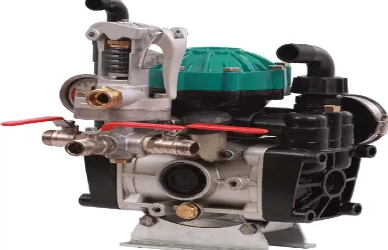
In most cases, yes. Boom sprayers and spot sprayers usually require different pump types because their operating demands differ in flow, pressure stability, and duty cycle.
A boom sprayer generally requires higher total flow because it feeds multiple nozzles continuously. It may also need extra pump capacity for agitation or bypass circulation. That makes pump performance under sustained operation a major factor.
A spot sprayer, on the other hand, often works with lower flow demand and more intermittent use. In many cases, a compact electric fertilizer sprayer pump is enough, as long as it provides the required pressure for the nozzle or wand.
There are situations where the same pump type can be used for both systems. For example, a diaphragm pump can serve either a small boom sprayer or a larger spot sprayer if the flow and pressure requirements overlap. However, the exact pump size and rating still need to be checked carefully.
The key point is this: do not select based only on the words “boom” or “spot.” Select based on actual operating conditions.
Two sprayers with different names may have similar requirements, while two boom sprayers may need completely different pumps depending on width, nozzle count, and operating speed. That is why pump selection should always start with real system demand.
Choosing the right fertilizer sprayer pump becomes much easier when you understand the main differences between boom and spot spraying systems.
Flow demand is often the biggest difference. Boom sprayers usually run multiple nozzles at once, so total flow can be much higher than in a spot sprayer. A spot sprayer may need only enough flow for a wand or one nozzle, while a boom system may need several times that amount.
Many fertilizer applications depend on consistent droplet size and spray pattern. Boom systems are especially sensitive to pressure variation because uneven pressure affects multiple nozzles at once. Spot sprayers also need stable pressure, but the impact is usually localized.
Boom sprayers are often used for longer, continuous runs. This demands a pump designed for sustained operation. Spot sprayers are often used intermittently, which can favor compact electric pumps with automatic pressure switching.
Boom systems may use PTO-driven, engine-driven, or larger electric pumps depending on equipment size. Spot sprayers often rely on battery-powered systems, especially 12V units. If portability is important, pump weight and power draw become major selection factors.
Different pump technologies serve different needs, and each has strengths and limitations.
Diaphragm pumps are widely used in spraying systems because they can offer good pressure capability and are often suitable for chemical applications. They are common in both boom and spot sprayers, especially when chemical compatibility and self-priming performance matter.
Roller pumps are often chosen as a practical, cost-effective option in certain farm setups. They can work well in some boom sprayer systems, but users should always check compatibility with the fertilizer solution and maintenance requirements.
Centrifugal pumps are often selected for larger boom sprayers where high flow is needed. They can be a strong choice for high-volume applications, but they are not always ideal for every small or portable setup.
Compact electric pumps, especially 12V diaphragm pumps, are common in spot sprayers. They are easy to install and convenient for mobile units, making them a practical fertilizer sprayer pump choice for targeted applications.
Not always. A pump that performs well with water may not have the right material compatibility for liquid fertilizer. Fertilizer solutions can affect seals, valves, and pump housing over time, so compatibility should be verified before use.
Yes, especially in mobile systems or applications with frequent start-stop operation. A self-priming fertilizer sprayer pump can improve startup reliability and reduce downtime when suction conditions change.
Duty cycle has a major impact on service life. If an intermittent-duty pump is used for continuous operation, it may overheat, wear faster, and fail earlier. Matching the pump to the expected duty cycle improves reliability and reduces maintenance costs.
It is usually smart to allow some margin, especially if you may expand nozzle count, boom width, or system capacity later. However, oversizing too much can also create control and efficiency problems, so sizing should be balanced and practical.
Boom sprayers and spot sprayers may look similar, but they often require different pump solutions because they operate in different ways. The best fertilizer sprayer pump is not chosen by label alone—it is chosen by flow demand, pressure requirements, duty cycle, power source, and chemical compatibility.
If you select the pump based on real operating conditions, you will get better spray consistency, more reliable performance, and a longer service life. For buyers and distributors, this also means fewer complaints, less rework, and better long-term value.